WFC News
Yu-ai Friendship
Newsletter of the World Friendship Center, NPO
Participating in the Korean PAX
Matsue Matsumoto
I participated in the Korean PAX from April 30 to May 5. During this trip, I visited places where we usually could not go, and had very valuable experiences.
I participated in a protest meeting which was held in front of the Japanese Embassy on Wednesday May 1. The protest meeting is held on every Wednesday. In the afternoon, we went to Seodaemun Prison History Hall. On May 2, we visited the Comfort Women Historical Museum and met a Korean woman at House of Sharing. They both depicted negative legacies of the Imperial Japanese Army.
At the anti-Japan demonstration on Wednesday, a priest of the Methodist church offered his message and prayer. I couldn’t understand Korean, so I had no idea what he was saying. In the bible, Matthew 5:44 says “Love your enemies! Pray for those who persecute you!” I couldn’t understand what kind of message he offered and how he prayed for people in the demonstrations.
At the site of Seodaemun Prison History Hall, prison houses are preserved and open to the public. Activists in the independence movement were imprisoned here during the Japanese colonial period. The prison houses were also used by the Korean government after World War II. They were the buildings where tortures and death penalties were performed.
At House of Sharing, Tsukasa Yajima, a Japanese, showed us a video of the activities and protest of Ms. Kang Duk-kyung who was the first to proclaim the comfort women issue. We saw her pictures that she drew for her mental health. Each picture depicted her crying heart – a feeling I could share. After that, I met two Korean women. Their names and ages were the same. One of them looked calm as she told her story. I thought she had a strong will which would not be daunted and would persevere through anything. When I asked her “What do you want us to do? What do you want?” She answered, “Apology and compensation.” The other was a woman free from care.
On the night of the second day, I made an apology and told the A-bomb experience. During questions and answers session after my presentation, someone asked “Why don’t you ask America for an apology? You had terrible experiences due to the A-bomb.” I answered, saying “Many American people agree that the A-bomb ended the war sooner. The Japanese proverb says, ‘Leave the past in the past. Cover up what smells bad.’ Many Japanese don’t ask for apology. Some young Japanese don’t know that once Japan fought against America. Today, the power of nuclear weapons is about 4000 times as strong as that of the A-bomb dropped on Hiroshima. One bomb would contaminate half of the earth with radiation. From a humanitarian standpoint, such a powerful weapon must not be used. However, some countries possess them. I am making efforts to abolish nuclear weapons.” I don’t know whether they understood what I meant.
There is a culture of “hatred” in Korea we Japanese can’t understand. They harbor this feeling for a long period of time in their minds. However, Kim Yog-Won an author of Social Psychology (1989), points out that the Korean are very generous people and forgive others, and can accept their fate due to “hatred”. I think that both aspects are true. I can understand the Korean people seek for an apology from the top person for war responsibility. If the number of people who support the latter aspect is larger than that of the former, I think we can find a clue to reconciliation. Today, the relations between Japan and Korea are strained. I hope from now on, that young people try to solve the Japan-Korea issue.
Translated by Sachiko Hiraoka
Copyright © NPO World Friendship Center 2019 All Rights Reserved
Yu-ai Friendship
Newsletter of the World Friendship Center, NPO
Impressions of participating in this Korea PAX
Iori Fujimoto
This Korean PAX was my first time living overseas, and also the first cross-cultural exchange. Participating in this program gave me a lot of experience and knowledge.
First is the history of Korea. In this program, I mainly learned about the issue of comfort women. Through this study, I fully realized how Japan turned away from the issue of comfort women, and how painful the victims and bereaved people felt. Because we Japanese are not interested in this issue at all, are not educated, and are very rude to the other party, We felt that we had to be more aware, and be more active and appeal to the government to get closer to the solution, so that we can build a good relationship between our two countries. Also, at the question and answer time about Ms. Matsumoto’s testimony of the exposure to the A-bomb, I clearly felt the difference in thinking between the Japanese and Korean, such as “Why Japanese forgave Americans for the atomic bomb” and “Why we never ask for apologies”. I thought that this difference in thinking also cause us missing each other.
Next is Korean culture. This was mainly due to homestaying, and it was possible to obtain an experience that could not have been obtained by sightseeing while staying in a hotel. For example, handmade Korean food, shops that only locals know of, you can feel the local culture more directly than famous tourist spots. In addition to meals and sightseeing, I was able to learn a little bit of Korean through conversations with my host family, local people, and children.
Lastly, what I think was the best part of participating in this program is that I gained a new family. It’s my host family, but they welcome me warmly from the first day, treat me like a real family every day, and on the last day they said, “You are our family, come to Korea. Whenever you come, you can stay here anytime. “
All of these experiences were something that could never be gained by ordinary sightseeing or travel, and even though it was a short period of only 6 days, it was a very deep and meaningful time, and it was a program that I was really glad to participate in. I would like to express my heartfelt thanks to the people at the WFC and the Peace building for giving me this wonderful opportunity.
Thank you very much.
Translated by Minao Capper
Copyright © NPO World Friendship Center 2019 All Rights Reserved
Yu-ai Friendship
Newsletter of the World Friendship Center, NPO
Korea PAX
Minao Capper
On my trip to Korea though PAX I wanted to find out what the Korean youth feel about peace, understand more about the historical problems between Japan and Korea, and experience the Korean culture. I especially think I now understand the issue about the Korean women forced to be sex slaves by the Japanese military, and I could see it from a different perspective than before.
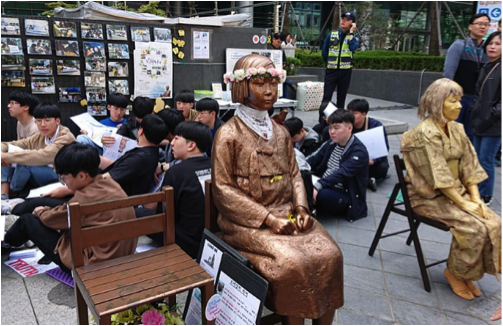
On the first day, we joined a protest in front of the Japanese embassy. I was surprised that there were many young people, even though it was a national holiday. They were very different from the Japanese students who just sit there quietly because they were told to, but instead they were actively chanting and singing songs. The young people taking it upon themselves to act on what they think is really impressive and inspired me a lot.
On the second day we went to the house of sharing and learned about the horrific things that the Japanese military made these women do in wartime.
When we heard from the Harumonis it made me think that the terrible things that we saw in the museum had happened to these women sitting in front of me.
That thought made me tear up. Going to a Japanese school and studying the Japanese peace education all my life, learning about the truth for the Koreans hurt my heart. All the Harumonis want is a formal apology and for the stories of the so called “comfort women” in the school textbooks. I can’t understand why the Japanese government can’t do that. I said this at the Q and A after Matsumoto san’s story on the third day but, I think if we don’t learn about our past mistakes, we will not be able to achieve a truly peaceful future.
During the Q and A on our third night, I got to see many different perspectives while translating, and when I was asked about what the Japanese youth think or what kind of peace education I had, I did my best to answer those questions but I felt I wasn’t answering the questions as well as I could. Not many people are as privileged as I am to be able to take part in such trips so at the very least, I want to tell my opinions and my experience in Korea to my friends and teachers in Japan.
On our final day we went shopping with my host family, Coco and Austin.
When we got back to the peace building we had diner all together then got in a circle to talk about our memories during our stay. I am so thankful for my amazing host family and all the people who made this possible. I will never forget this experience.
Copyright © NPO World Friendship Center 2019 All Rights Reserved
Yu-ai Friendship
Newsletter of the World Friendship Center, NPO
2019 Korean PAX report
Shizuo Tachibana
I visited South Korea from April 30 to May 5, 2019 as group leader of the Korean PAX tour, the Peace Ambassador Exchange. I would like to share a few thoughts regarding this Korean PAX.
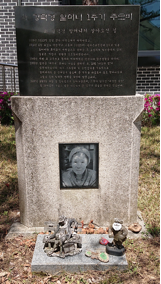
We visited the House of Sharing for victims of Japanese military sexual slavery on May 2. There we met one of the grandmothers, 이옥선 Ii Ukseon, and I apologized to her as a Japanese person. However, she said that she wanted an apology from the Japanese government, not from me. She said that she didn’t expect an apology from the Prime Minister, Shinzo Abe. Hearing that for her my apology meant nothing, I was shocked. At the political level between two countries, there are so many issues going on that need to be resolved. The grandmothers have seven demands, the Japanese staff of the House of Sharing, Mr. Tsukasa Yajima told us. The Japanese government has to answer to these seven demands, which the present government chooses to ignore. Is there anything left, then, that we Japanese citizens can do for these victims of sex slavery?
On May 2, after Ms. Masue Matsumoto shared her experience of the A-bombing, there was a question to her. ‘Why don’t the Japanese ask for an apology from the U.S.?’ She explained about a characteristic attitude of Japanese people to experiences in the past. The Japanese tend to forget what happened, as one releases incidents in the stream of memory. It is not only her, but many hibakusha don’t especially want an apology from the U.S. Instead they say that they don’t want anyone to experience what they did. I know that the Japanese have to apologize and seek to be forgiven because of the war. The Korean grandmothers need an apology from the Japanese government. However, I hope that as Japanese people continue to visit the victims of the sex slavery with their apologies and a heart of love, these may heal them and they will someday accept our apologies. I believe that this is one of the things that Japanese citizen could do about the past.
In the end, I would like to express my sincere thanks to the Peace Building Community for their warm welcome and commitment to this program dedicated to peace between our countries. I hope that Korean PAX will continue to contribute to the peace of this region.
Copyright © NPO World Friendship Center 2019 All Rights Reserved
Yu-ai Friendship
Newsletter of the World Friendship Center, NPO
Joining the study tour to
Kyoto Museum for World Peace, Ritsumeikan University
Katsumi Takahashi
On a light rainy day at the end of January, we traveled to Kyoto to visit the Kyoto Museum for World Peace, Ritsumeikan University. There were eight of us in all: four WFC board members, four Hiroshima Pass-on-Project lecture participants. At Kyoto station, we were met by Ms. Yoshiko Tanigawa, a volunteer guide from the museum. She led us to a bus on which we headed for Ritsumeikan University at the foot of Mt. Kinugasa. According to her explanation, of its type as a university-established museum, it is unsurpassed in the world as regards its scale and exhibits. We were excited, looking forward to seeing all this.
At first we visited Suekawa Memorial hall, named after the honorary president Hiroshi Suekawa who was from Iwakuni. Mr. Suekawa’s relics exhibition was held there. There Ms. Rumi Hanagaki greeted us. She was exposed to the atomic bomb in Yokogawa at the age of five years old. Now she is a caretaker for the Kyoto atomic and hydrogen bomb survivors’ consultation group. After lunch at the restaurant in the hall and introducing ourselves, we heard Ms. Hanagaki’s testimony as a hibakusha. She said that the circumstances at the time of exposure to the blast, especially what she experienced while evacuating to Mitaki had returned to her years later as flashbacks.
Moving to the museum next door, the roses of Anne welcomed us at the entrance. Entering the building, there was a comfortable spacious lounge. On the east and west walls, two “Phoenix fire birds” reliefs by Osamu Tezuka representing the epidemic of past war to bright future were glowing lustrously, and we were met by the impressive enshrined Muchan Peace Statue. Ms. Tanigawa explained that Muchan was a girl with tuberculosis who had been kept quarantined alone in a shelter, and had starved to death without knowing that the war was over.
Then finally we went to the lower first floor to the main permanent display, “Staring at Peace”. The exhibition starts when you go down the stairs looking at the large Wadatsumi (God of the sea) statue along one side. The exhibits on this floor were divided into two themes: the “Fifteen years war” and “Modern wars”. For the “Fifteen years war”, there was a huge display of primary materials with easy to understand neutral explanations based on historical facts. I was deeply impressed. I was able to learn a lot of things which I hadn’t known.
This museum was established following deep reflection on the fact that Ritsumeikan had been a strongly militaristic school before the war. Everywhere I saw the strong intention to nurture the subject of creating peace.
Contents of the respective exhibitions were significant. The themes were: ① Military and soldiers (Characteristics of the imperial army), ② General public mobilization (War cooperation system), ③ Colonies and occupied territories (Anti-Japanese movement), ④ Air raids, the Battle of Okinawa, the Atomic bomb, ⑤ Efforts for peace (about the Japanese antiwar movement), and ⑥ Responsibility for war. Among the exhibits that remain strongly impressed in my memory are the heavy backpacks, up to 30kg, which the soldiers carried, an aerial photograph showing the plan to drop the atomic bomb on Kyoto, which had been among the first possible targets (a circle with a radius of 2.4 km from the Ume alley engine depot), and anti-Japanese slogans.
Then we went upstairs and looked around the “Peace Creation Exhibition Room”. Here, one area for reflecting on violence and peace was introduced, around the central theme of “Peace is not just the absence of conflict”. I became aware of the various issues that exist around us.
In the next room was an exhibition of works from art students who died in the war, kept in this Kyoto Hall section of the “Silent Hall” museum located in Ueda City, Nagano Prefecture. I faced the works of the art students who had lost their lives so young.
In this visit to the Kyoto Museum for World Peace, Ritsumeikan University, through the huge display of exhibits built on academic knowledge, I was able to gain some understanding of the stupidity of war and a realization that peace can be achieved through the proactive behavior of individuals. It was a very meaningful tour for our future peace activities.
Finally, I wish to express my appreciation to our guides, Ms. Tanigawa and Ms. Hanagaki, and to every member of the board of the World Friendship Center.
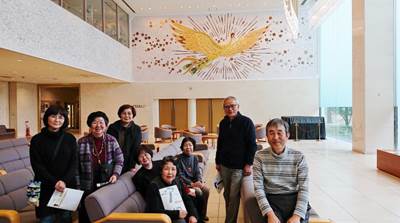
From left to right: Ms. Niki, Ms. Watanabe, Ms. Matsuno,
Ms. Miho, Ms. Kurumaji, Ms. Taguchi,
Mr. Takahashi, Mr. Tachibana
Translated Sumiko Kanetsuna
Copyright © NPO World Friendship Center 2019 All Rights Reserved